Definition
A discrete signal refers to a signal that exhibits discontinuity in its amplitude. While analogue signals are continuous with respect to time, the term "discontinuous" in this context pertains to variations in signal amplitude. Discrete signals, also known as digital signals, are a subject of study due to the advantages offered by digital processing [7].
The definition of sampling, a method for discretizing the analog signal x(t) into a discrete signal x(tn ) or x(n) or xn, is as follows:
\(t\in\left\{t_1,\ t_2,\ldots,t_n\right\}\ \ \ \ \ \ \ \ \ \ \ \ \ \ \ \ x\left(t_n\right)=x\left(n\right)=x_n\)
We recall that in sampling :
\(t_n=nT_e\)
\(t_{n+1}-t_n=T_e\ ,\ \ \ \ \ \ \ \ \forall n\)
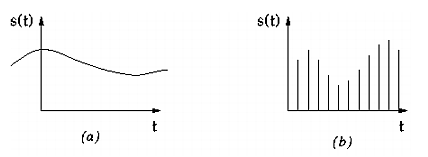
Figure 1: (a) Signal Continu, (b) Signal Discret.