الخطوط العريضة للقسم
-
Instructor: Dr. Abdelhalim Louifi.
Email: abdelhalim.louifi@enp-oran.dz
Target Audience: 2nd-year Automatic EngineeringFundamental Unit: UEM22
Course title: Industrial Electronics IICode: ELI2.
Credits: 04
Coefficient: 04
Duration: 14 weeks
Schedule:Lecture: Monday: 08:15 AM – 11:25 AMLaboratory : Sunday: 14: PM – 16:00 PM
Room: 115
Teaching Mode: In-person Lectures, Tutorials (TD), and Practical Labs (TP)Evaluation Method: Final exam (60%) and continuous assessment (30%: TP, projects, quizzes)
Availability:
-
Office hours: Sunday from 09:00 AM to 12:00 PM
-
Online: Any questions related to the course should be posted on the dedicated Moodle forum so everyone can benefit from the answer. I commit to responding within 48 hours. Email is reserved for emergencies (like platform access issues).
-
-

By the end of this course, students will be able to:-
Describe the fundamental concepts and components of Electrical Drive Systems.
-
Explain the operating principles of DC and AC motors and their control using solid-state converters.
-
Apply control techniques to analyze the performance of electric drive systems.
-
Analyze the behavior of different motor-drive combinations under various operating conditions.
-
Evaluate and select appropriate electric motors based on application requirements and performance criteria.
-
Identify and illustrate practical applications of electrical drives in industrial and real-world systems.
-
-
Students should be familiar with the basics of:
-
Power Electronics
-
Electric Machines
-
Control Systems
-
-
Electric drives constitute a fundamental domain in modern engineering, at the heart of numerous industrial applications and automation. Their main objective is the conversion and control of electrical energy into mechanical energy, allowing for precise control over the speed, torque, and position of motorized systems.
An electric drive system relies on the complex interaction between electric machines, power electronics converters, and control algorithms. In various contexts such as production lines, robotics, electric vehicles, or HVAC systems, these drives must guarantee high dynamic performance while optimizing energy efficiency in the face of various load disturbances.
This module aims to provide students with the theoretical and practical foundations necessary to understand the fundamental principles of the dynamics and control of electric machines. It notably covers the modeling of motors (direct current, asynchronous, and synchronous), the study of static converters (choppers, AC voltage controllers, inverters), as well as the associated control strategies.
Through a progressive approach combining theory, simulation, and practical applications, students will be guided to develop skills in the modeling, analysis, and sizing of drive systems. Particular attention will be given to the use of software tools such as MATLAB/Simulink, in order to bridge the studied concepts with real-world problems encountered in engineering.
Finally, this module is part of an active learning approach, where students are encouraged to experiment, analyze performance, and solve concrete problems directly related to industrial automation and process optimization.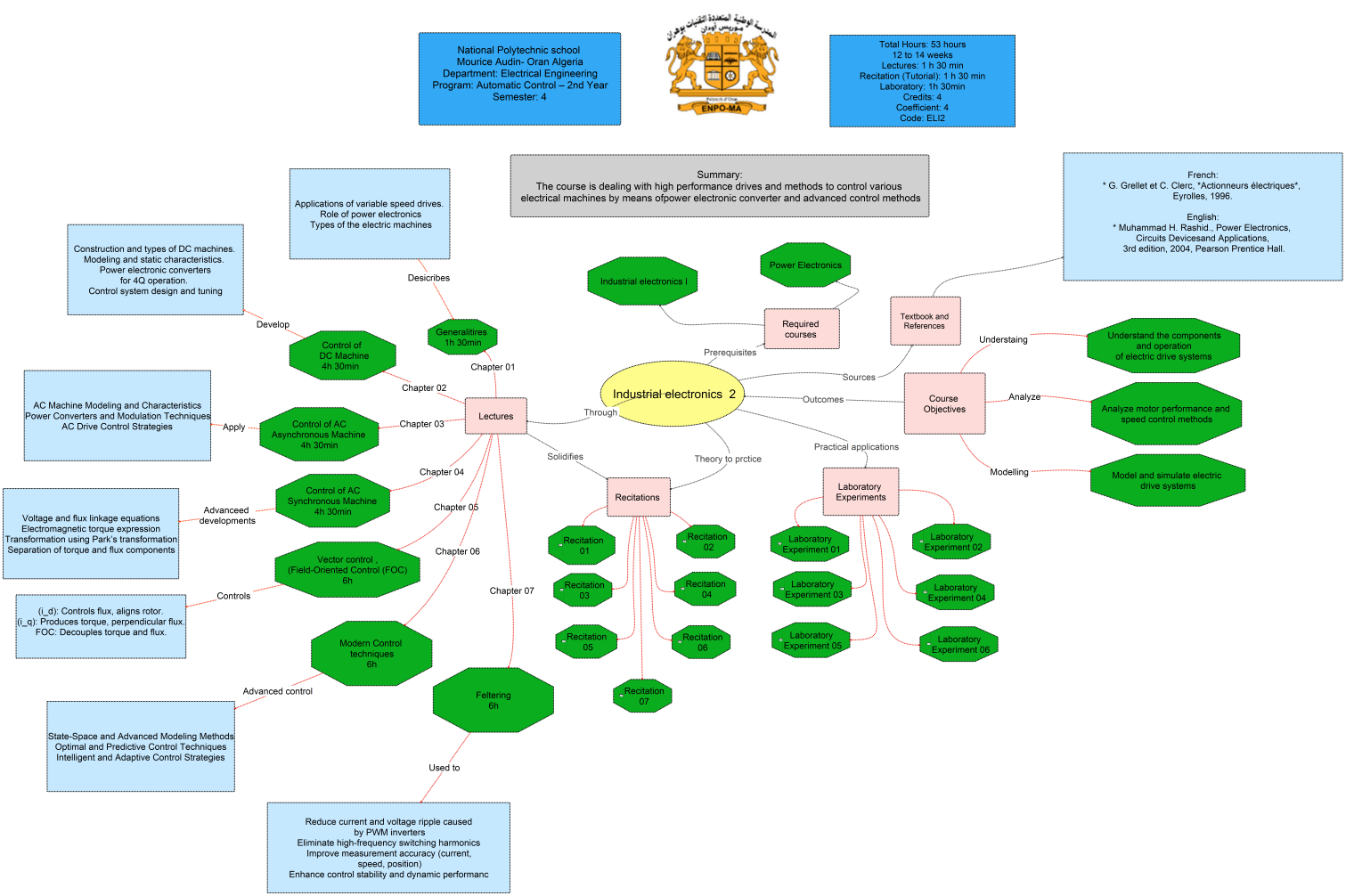
-
🏁 Conclusion
The Industrial Electronics II course provides students with the fundamental knowledge needed to understand industrial electronic systems and electric drives. It progressively introduces the main concepts and develops their application through the study of general concepts and DC drives.
The Moodle course provides a structured learning pathway from the prerequisites and introduction to the learning chapters, conclusion, and final assessment, supporting students in developing both theoretical understanding and practical engineering skills.
-
-