الخطوط العريضة للقسم
-
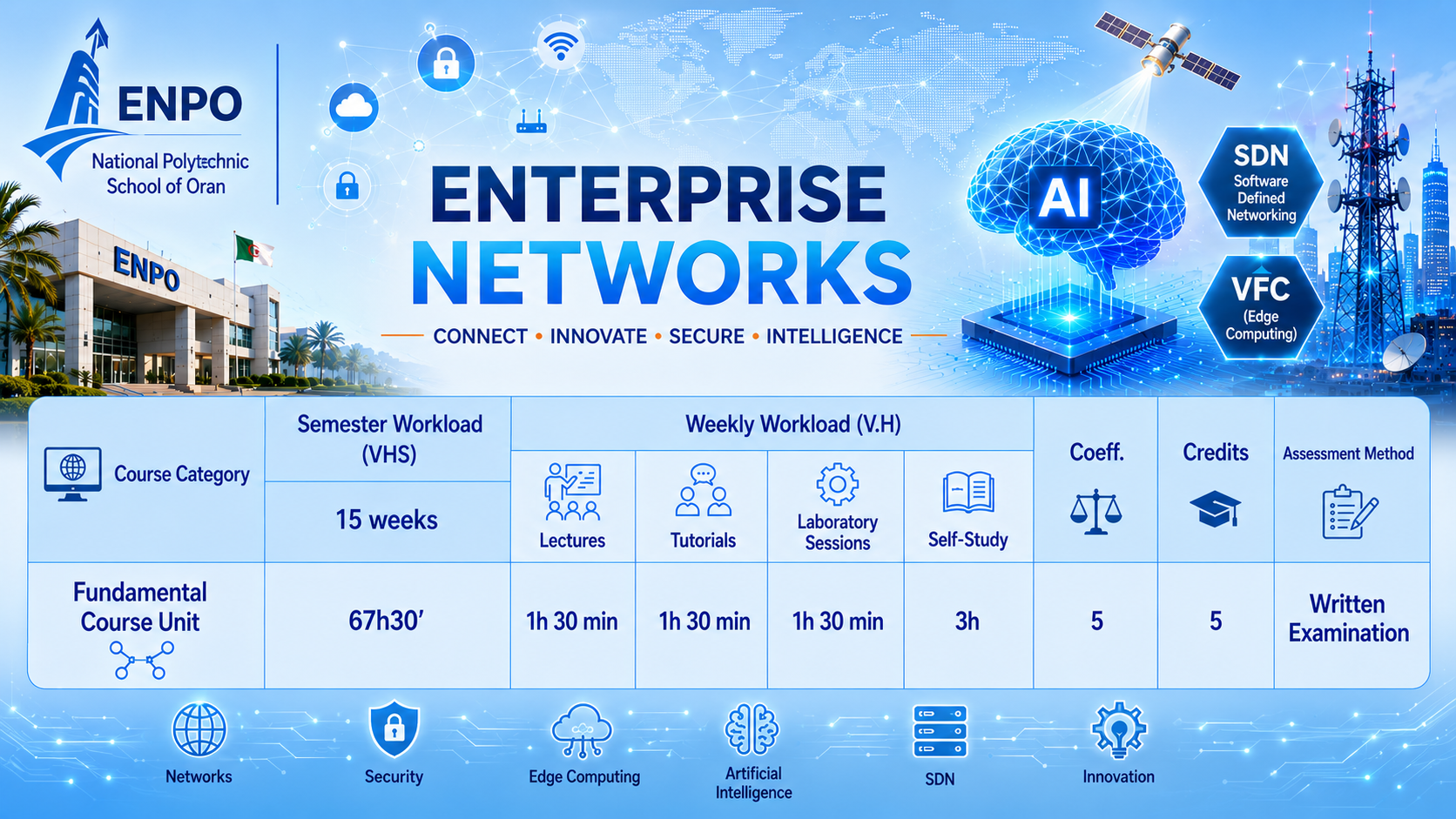
Course Title
Enterprise Networks
Course Unit Type
Fundamental Course Unit.
Semester Workload
First semester
(15 weeks)
67h 30min
Weekly Teaching Hours
Theoretical Course Hours
(Lecture Hours)
1h 30min
Tutorial Session Hours
1h 30min
Practical Session Hours
1h 30min
Self-Study Hours
3h
Credits
5
Coefficient
5
Assessment Method
Continuous Assessment and Final Examination
Instructor
Dr. Amal BOUMEDJOUT
Prerequisites
Computer Networks Fundamentals
Course URL
https://elearning.enp-oran.
dz/pluginfile.php/33388/mod_ resource/content/0/Enterprise_ Network_BOUMEDJOUT.pdf -
This course is designed for first-year engineering students in the IMSI and RIT specializations.
-
This glossary offers brief definitions of fundamental networking terms to assist learners in mastering computer network concepts.
-
This prerequisite test is designed to evaluate students’ fundamental knowledge required for the Enterprise Network course. It assesses basic concepts in computer systems, operating systems, Internet protocols, and networking fundamentals to ensure that students possess the necessary background to successfully follow the course.
-
-
This quiz aims to evaluate students’ mastery of Ethernet concepts by focusing on structural design, protocol functions, and operational characteristics that support data transmission in local area network environments.
-
-
This quiz is designed to check your solid understanding of IPv6 concepts and how they work in practice. It covers important topics such as address structure, prefix usage, automatic configuration methods, and router communication. The goal is to evaluate your ability to think critically and apply IPv6 knowledge in real networking situations.
-
-
This quiz evaluates students’ understanding of the Dynamic Host Configuration Protocol (DHCP), including the DORA process, lease renewal mechanisms (T1 and T2), message types, and IP address allocation principles.
It assesses both conceptual knowledge and practical comprehension of DHCP operations within IPv4 networks.
-
-
This forum invites students to analyze a common network connectivity issue encountered in enterprise environments. By examining the given scenario, students should apply their knowledge of IP addressing, DHCP configuration, and basic network troubleshooting to identify the possible causes of the problem and suggest appropriate diagnostic and resolution steps. The objective of this discussion is to reinforce the understanding of network configuration mechanisms and develop analytical thinking in practical networking situations.
-
-
Black, U. (2000). Data Networks (2nd ed.). Prentice Hall.
Cisco Networking Academy. (2020). Introduction to Networks (ITN). Cisco Press.
Comer, D. E. (2014). Internetworking with TCP/IP, Volume 1: Principles, Protocols, and Architecture (6th ed.). Pearson.
Comer, D. E. (2015). Computer Networks and Internets (6th ed.). Pearson.
Droms, R. (1997). Dynamic Host Configuration Protocol (DHCP). RFC 2131. Internet Engineering Task Force (IETF).
Forouzan, B. A. (2013). Data Communications and Networking (5th ed.). McGraw-Hill Education, New York, USA.
Halsall, F. (2005). Data Communications, Computer Networks and Open Systems (4th ed.). Addison-Wesley.
Hinden, R., & Deering, S. (2017). Internet Protocol, Version 6 (IPv6) Specification. RFC 8200. IETF.
IEEE Computer Society. (2015). IEEE 802.2 Logical Link Control (LLC) Standard. IEEE.
IEEE Standards Association. (2018). IEEE 802.1 LAN/MAN Bridging and Management Standards. IEEE.
IEEE Standards Association. (2022). IEEE 802.3 Ethernet Standard. IEEE.
Keiser, G. (2011). Optical Fiber Communications (4th ed.). McGraw-Hill.
Kurose, J. F., & Ross, K. W. (2021). Computer Networking: A Top-Down Approach (8th ed.). Pearson.
Mockapetris, P. (1987). Domain Names – Concepts and Facilities. RFC 1034. IETF.
Narten, T., Draves, R., & Krishnan, S. (2007). Privacy Extensions for Stateless Address Autoconfiguration in IPv6. RFC 4941. IETF.
Perlman, R. (2000). Interconnections: Bridges, Routers, Switches, and Internetworking Protocols (2nd ed.). Addison-Wesley.
Postel, J. (1981). Internet Protocol. RFC 791. Internet Engineering Task Force (IETF).
Rekhter, Y., Li, T., & Fuller, V. (2006). Classless Inter-Domain Routing (CIDR): The Internet Address Assignment and Aggregation Plan. RFC 4632. IETF.
Senior, J. M., & Jamro, M. Y. (2009). Optical Fiber Communications: Principles and Practice (3rd ed.). Pearson.
Stallings, W. (2017). Data and Computer Communications (10th ed.). Pearson.
Tanenbaum, A. S., & Wetherall, D. J. (2011). Computer Networks (5th ed.). Pearson.
Thomson, S., Narten, T., & Jinmei, T. (2007). IPv6 Stateless Address Autoconfiguration. RFC 4862. IETF.