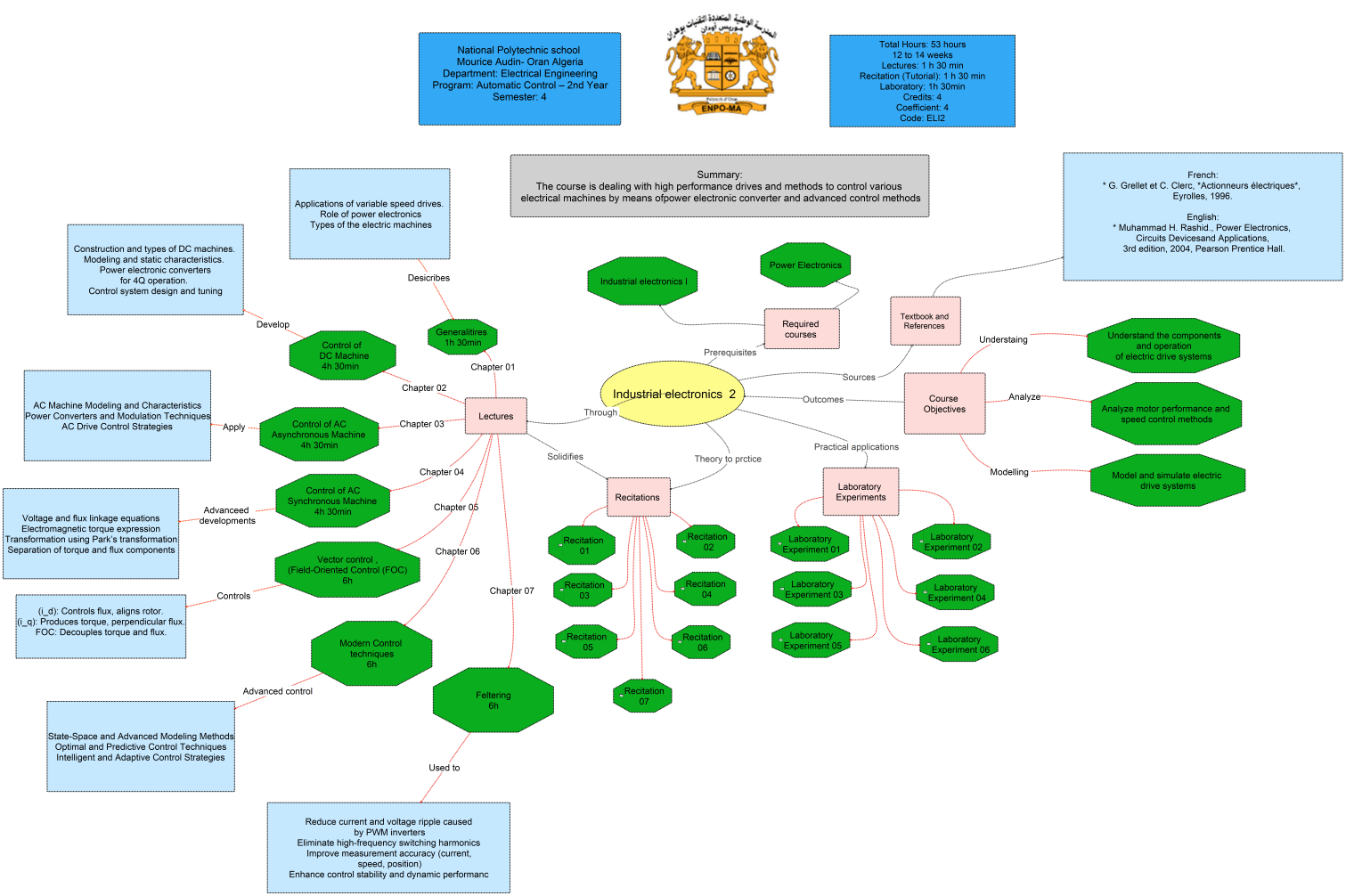
Electric drives constitute a fundamental domain in modern engineering, at the heart of numerous industrial applications and automation. Their main objective is the conversion and control of electrical energy into mechanical energy, allowing for precise control over the speed, torque, and position of motorized systems.
An electric drive system relies on the complex interaction between electric machines, power electronics converters, and control algorithms. In various contexts such as production lines, robotics, electric vehicles, or HVAC systems, these drives must guarantee high dynamic performance while optimizing energy efficiency in the face of various load disturbances.
This module aims to provide students with the theoretical and practical foundations necessary to understand the fundamental principles of the dynamics and control of electric machines. It notably covers the modeling of motors (direct current, asynchronous, and synchronous), the study of static converters (choppers, AC voltage controllers, inverters), as well as the associated control strategies.
Through a progressive approach combining theory, simulation, and practical applications, students will be guided to develop skills in the modeling, analysis, and sizing of drive systems. Particular attention will be given to the use of software tools such as MATLAB/Simulink, in order to bridge the studied concepts with real-world problems encountered in engineering.
Finally, this module is part of an active learning approach, where students are encouraged to experiment, analyze performance, and solve concrete problems directly related to industrial automation and process optimization.